
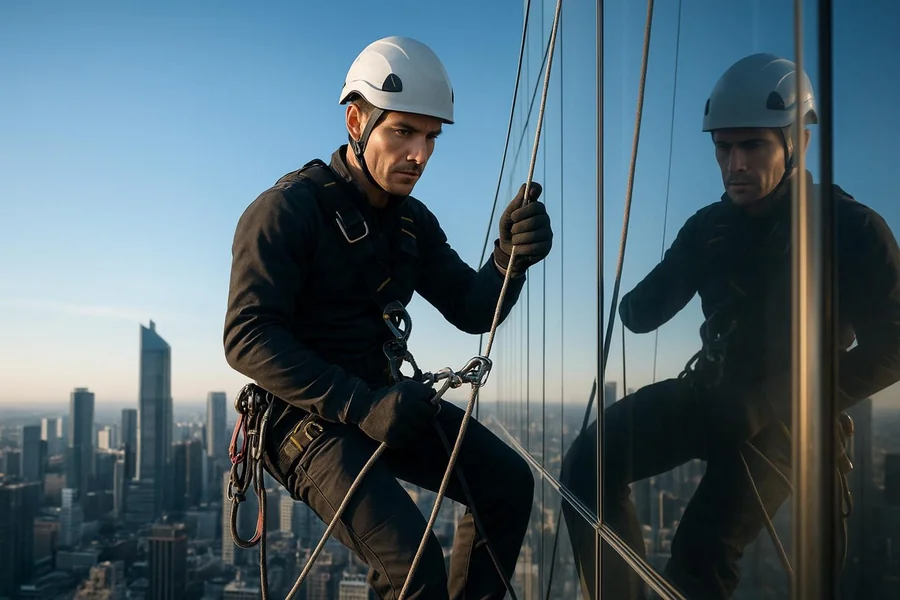
Professional rope access work can look like a risky dance of skill and control at great heights. In reality, it is supported by a very strong set of safety standards. These are not simple suggestions. They are detailed rules and procedures built so every technician can get back to the ground safely. Rope access safety standards work in layers, including strict training, approved equipment, clear work procedures, and ongoing checks. This is why rope access is often seen as one of the safest ways to work at height.
This strong focus on safety is why rope access is now used for many hard jobs, from checking tall structures to carrying out detailed repairs. For example, in busy city areas, rope access building maintenance in London depends on these standards to handle jobs like window cleaning and façade repairs on high-rise buildings in a safe and efficient way. This article explains the main parts of these safety standards, and how they are created, put into practice, and kept in place, so rope access stays efficient and, most importantly, safe.
Why Are Safety Standards Crucial in Rope Access?
Any job done at height has risks. Rope access stands out because the industry works hard to reduce those risks with clear systems and strict rules. Hanging on ropes far above the ground demands a serious approach to safety. With the right precautions, a task that could be seen as “high risk” can be done safely.
Without these protections and strict standards, the chance of serious injury or death from a fall would always be there. This is why the industry focuses on reducing mistakes and making sure every part of a rope access job is planned and checked. The goal is not to pretend the danger is not real, but to manage it directly with several layers of protection and trained people.
Risks and Hazards of Rope Access Work
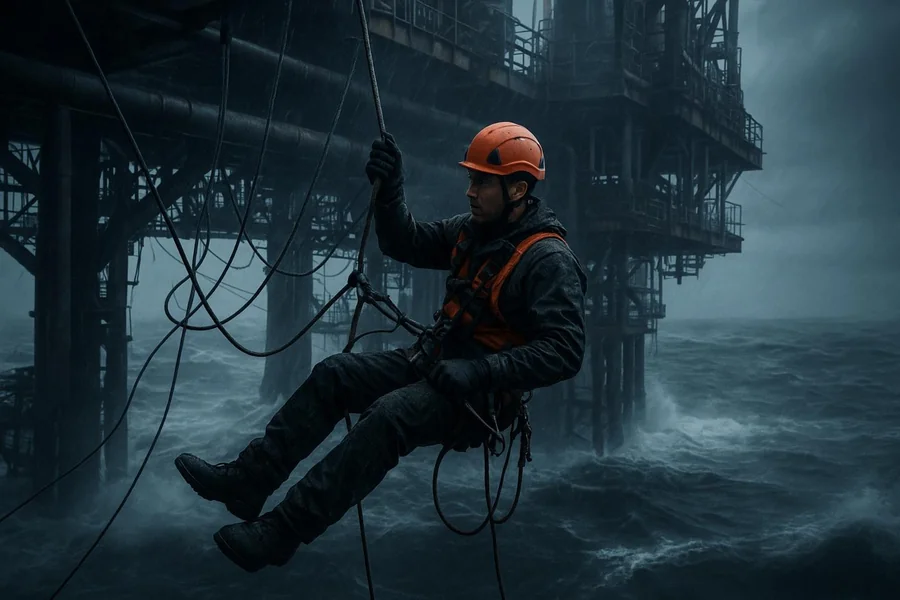
Even with a strong safety record, rope access work has its own hazards. Technicians deal with weather, such as wind, which can affect rope movement, body position, and the work area. They may also need to move around difficult building shapes, tight spaces, or awkward designs, which adds risk compared with ground-level work. Equipment failure is another risk, but this is reduced through regular inspections and backup systems.
The work is also physically demanding. Technicians need strength, balance, and good awareness of hazards. Tools or debris can also fall from height, which can put people below at risk. This is why ground safety controls and clear communication are so important.
Accident Statistics and Industry Safety Records
Although many people assume rope access is dangerous, it has a strong safety record. Accident rates are often lower than traditional access methods like scaffolding or boom lifts. This is backed up by documented figures, showing that strong training and strict work rules make a real difference. Rope access is also tightly controlled compared with many other industrial tasks.
One reason for the low accident rate is the use of detailed method statements for each job. These documents explain how the work will be done, what the hazards are, and what equipment is needed. Careful planning, along with high training levels and close supervision, keeps safety as the main focus and makes rope access a very secure option for work at height.
What Safety Standards Govern Professional Rope Access Work?
Rope access safety is not left to luck. It is controlled by a mix of international and national standards, regulators, and industry groups. Together, they set the requirements for training, equipment, and work practices that companies and technicians must follow. This creates a consistent safety level across different countries and job types.
Because of this wide system of rules, rope access work follows common safety principles almost everywhere. This consistency helps protect the industry’s reputation and supports its strong safety results.
Key Organizations Setting Safety Standards
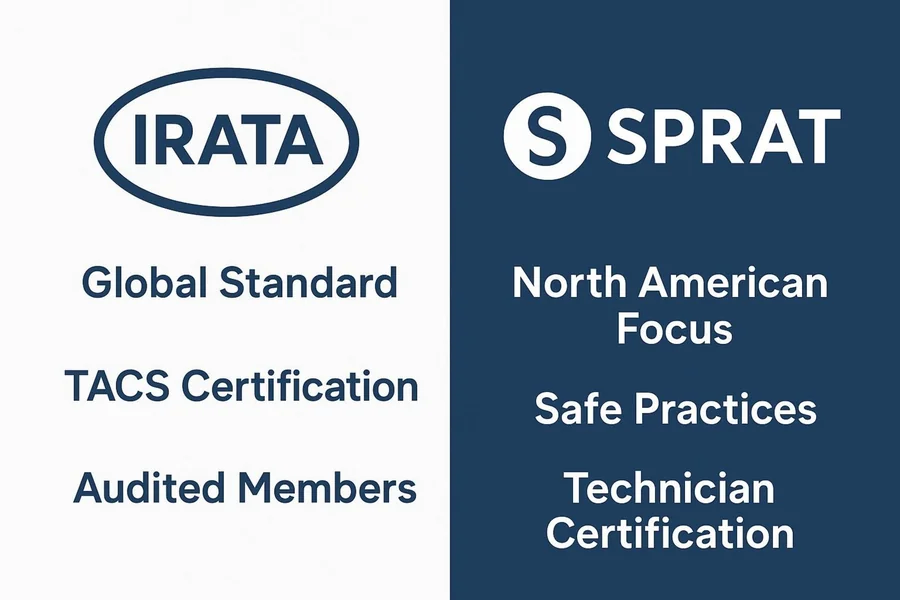
Two main organizations set global benchmarks for rope access: the Industrial Rope Access Trade Association (IRATA) International and the Society of Professional Rope Access Technicians (SPRAT). They are different groups, but both control training and certification and set high standards for safe work. Outside of these, national regulators like the Occupational Safety and Health Administration (OSHA) in the United States, and standards bodies like the American National Standards Institute (ANSI), also shape safety rules for rope access.
These organizations review and update guidance regularly, using lessons learned from real jobs and new technology. This helps keep standards current and helps protect workers and the public.
IRATA Guidelines
IRATA International is one of the best-known and most influential groups in industrial rope access. It controls rope access training and certification worldwide. IRATA training follows its Training, Assessment and Certification Scheme (TACS), which supports consistent skill levels across countries. For example, ropes used in rope access must meet the standards set by IRATA International.
Companies that want IRATA membership must prove they follow the rules through regular audits. IRATA members also give clients detailed method statements for each job, clearly explaining procedures, safety steps, hazards, and required equipment. This helps build a strong safety culture.
SPRAT Guidelines
The Society of Professional Rope Access Technicians (SPRAT) is another major authority, especially in North America. Like IRATA, it runs certification programs for rope access technicians and focuses on advanced training and following its Safe Practices for Rope Access Work. SPRAT guidance covers many safety topics, including equipment choice and environmental conditions such as wind and how it affects rope systems.
SPRAT also keeps a Work at Height Standard Reference with equipment standards, plus a Presiding Regulatory Authority Reference to help with legal compliance. With structured training and ongoing professional development, SPRAT-certified technicians are prepared for difficult job sites, while still matching global practices used by IRATA.
Relevant OSHA and National Standards
Along with industry certification, rope access work must follow local and national laws. In the United States, OSHA standards like OSHA 1910.27 (Rope Descent Systems) and 1910.28 (Fall Protection) apply directly to rope access. These rules set the legal minimum for working safely at height and explain employer duties and worker protections.
ANSI standards also matter, including ANSI Z359.14 (Fall Protection & Equipment Standards) and the newer ANSI Z459.1 Standard on Safety Requirements for Rope Access Systems. ANSI Z459.1, written under the ANSI Z359 Fall Protection Code, sets key requirements for equipment, systems, and training in a way that matches OSHA and other ANSI fall protection rules. It supports consistent practices across the industry, including using a two-rope system, wearing a full-body harness, and using autolocking connectors.
What Are the Core Requirements of Rope Access Safety Standards?
The foundation of rope access safety comes from strict core requirements. These cover technician skill, job planning, and how work is carried out. The goal is to build several safety layers so risks are found, checked, and reduced before anyone leaves the ground.
This wide approach means safety is not just about paperwork. It is about building habits where safety comes first during planning, during the job, and at the end.
Certification and Competency Levels for Technicians
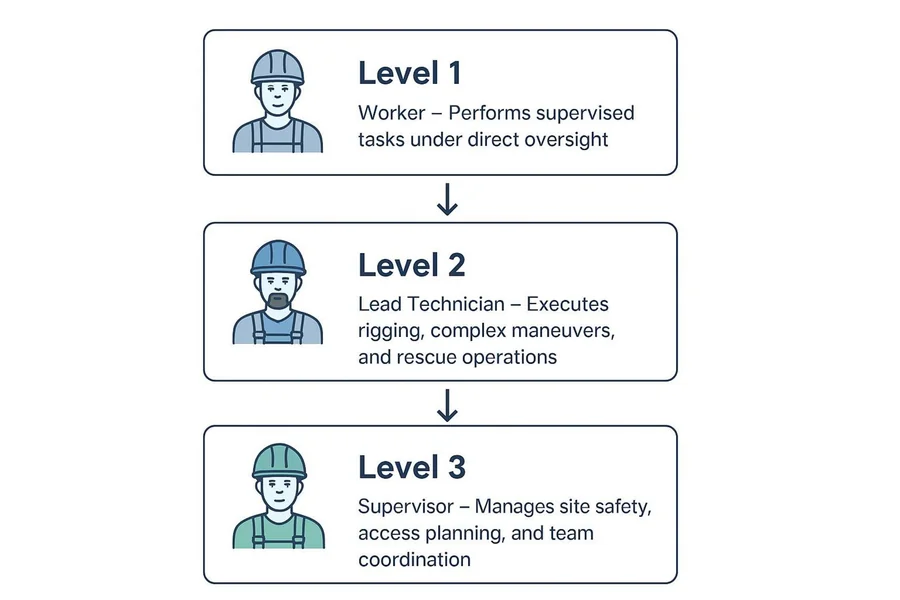
Rope access technicians follow a level-based certification system, mainly set by IRATA and SPRAT. Each level has its own training needs, experience requirements, and job duties. Moving to a higher level requires more training and a set number of logged hours, so added responsibility matches real experience and proven skill.
All technicians, at every level, complete strict training that covers laws, rescue methods, and hazard awareness. Regular checks and ongoing skill development help keep the industry’s safety standards high.
Level 1: Rope Access Worker
A Level 1 Rope Access Worker is the starting point. These technicians learn the basics of rope access systems, including how to move safely using a double rope setup. They do a limited range of tasks under close supervision from a Level 3 technician. Key duties include following job safety analyses (JSAs), using approved equipment correctly, and doing careful pre-use checks on personal gear and anchor points.
Level 1 technicians can carry out basic work, but always as part of a supervised team so their skills are used in a controlled and safe setting.
Level 2: Lead Technician
A Level 2 Lead Technician has stronger skills than Level 1 and can handle more complex rigging and rescue tasks. They can supervise Level 1 workers, support rescues, and help make sure site safety steps are followed closely. They also review anchor setups and check that equipment works well together, acting as a key link between the team and the Level 3 supervisor.
To reach Level 2 in IRATA, a technician usually needs at least 1,000 logged hours over at least 12 months. This supports real on-site experience. Even with higher skills and leadership tasks, Level 2 technicians still work under the authority of a Level 3 supervisor.
Level 3: Supervisor and Responsibilities
The Level 3 Supervisor is central to any rope access job. They have full knowledge from Levels 1 and 2 and strong skills in rigging and rescue. They hold a first-aid certificate, understand relevant work methods and laws, and know IRATA’s TACS or SPRAT’s Safe Practices well. A Level 3 supervisor can take full responsibility for rope access safety on a project, including planning, rescue readiness, and documentation.
Their work includes signing off inspections, certifications, and compliance reports, and overseeing all rope access and fall protection activity. They put the work plan into action, find and control hazards, confirm safe rigging, set rescue steps, support training, and keep team communication clear. A Level 3 supervisor may also work on the ropes, but only if the rescue plan clearly allows for another capable technician to rescue them quickly if needed.
Minimum Team Size and Supervision Requirements
A basic safety rule in rope access is that technicians do not work alone. A rope access team must have at least two rope technicians, so help is available right away if something unexpected happens. At least one person on the team must be a Level 3 Supervisor. This means a highly experienced and fully qualified person is on site to keep standards in place and manage emergencies.
Team size can increase based on the job’s difficulty, size, and location. Rescue needs are a major factor in deciding how many people are required. Having enough people, led by a Level 3 supervisor, is a big reason rope access has such a strong safety record — and why specialist firms such as Rope Access in London follow these team standards on every job.
Pre-Work Planning, Risk Assessment, and Permit Systems
Before rope access starts, detailed planning is required to reduce mistakes. This includes written procedures and forms that set the plan. Common documents include Rope Access Operating Procedures, a Rope Access Risk Assessment, Method Statements, a Rope Access Plan, a Rescue Plan, and Daily Field Level Risk Assessments with Safe Work Practices.
Method statements are key because they explain the job steps, safety controls, hazards, and equipment needed. OSHA also requires a rescue plan for every job, and it must be practiced. This careful planning means risks are found early, control steps are set, and emergency actions are ready, helping protect technicians and the public during the work.
What Equipment Is Required to Meet Safety Standards?
Professional rope access equipment is specialized and built for tough conditions at height. It is also carefully maintained. Each item, from ropes to connectors, plays a part in the safety system and must meet strict rules and inspection requirements.
This focus on equipment quality and condition supports the industry’s goal of protecting technicians and keeping equipment reliable.
Types of Harnesses, Ropes, and Fall Protection Gear
Rope access uses industrial climbing equipment, similar to gear used by arborists or climbers, but set up for industrial work. The ropes are central. Dynamic ropes stretch a little, which helps absorb force in a fall. A key rule is the two-rope system: a main working rope plus a backup rope, so there is always a second line of protection.
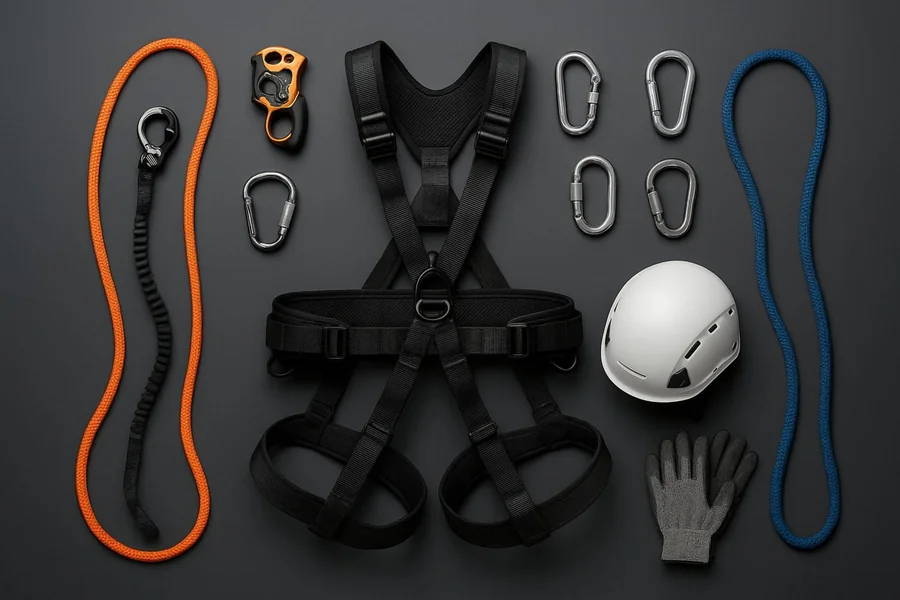
Technicians wear full-body harnesses, often ANSI Z359-approved, to spread forces in a fall. Mechanical devices like ascenders and descenders allow controlled movement up and down. Lanyards, including shock-absorbing and positioning types, connect the harness to anchors and may include energy absorbers to reduce impact during a fall. Basic personal protective equipment (PPE) includes helmets for head protection and falling objects, and gloves for grip and hand safety. Other key items include connectors, footloops, and pulleys, each made for specific roles in the system.
Anchor Points and Structural Considerations
Anchor points connect the rope system to the structure. They are attached to the building or structure and must support the combined load of the worker and equipment. A core rule is that the working rope and the backup rope must be fixed to separate, independent anchor points. If one anchor is damaged or fails, the other still holds.
All roof anchor points must be certified, and yearly roof anchor certification is required for all tie-off systems to confirm they stay in good condition and meet rules. During planning, engineers and Level 3 supervisors review load capacity and choose suitable anchor locations to keep safety high.
Inspection, Maintenance, and Equipment Lifespan
Rope access gear stays reliable through strict inspection and maintenance routines. Before and after use, equipment is checked by trained staff. This helps spot defects early, even small ones, so they can be fixed or the item can be removed from use before it becomes a risk. Shine On technicians, for example, log and tag all gear before and after each use to maintain compliance.
Beyond daily checks, equipment must meet ANSI and manufacturer requirements for strength, correct operation, and set inspection schedules. Many items also have a defined lifespan and must be retired after that period even if they appear fine. This full system of selecting, checking, and retiring gear supports the trust technicians place in their equipment.
Compliance Certification and Markings
Every item in a professional rope access system must be suitable for the job and also show the correct safety markings and certifications. This includes ropes, harnesses, connectors, and other fall protection equipment. Certifications from groups like ANSI, IRATA, or SPRAT show the equipment was made and tested to meet set safety and performance levels. For example, connectors and carabiners are often rated to 5,000 lbs, and full-body harnesses must be ANSI Z359-approved.
Technicians and supervisors learn how to check and confirm these markings so only properly rated, legally compliant equipment is used. This adds another layer of safety to rope access work.
How Are Rope Access Safety Procedures Implemented On Site?
Putting safety standards into real site work is where rope access safety shows its strength. It requires ongoing attention, clear planning, and fast response to changes. Safety for technicians and the public is managed continuously through the whole job.
From rigging ropes to packing equipment away, every step follows a system meant to stop problems before they happen and to reduce risk as work continues.
Double Rope System and Redundancy Principles
The main safety idea in rope access is redundancy, meaning there is always a backup. On site, this starts with two separate ropes for each technician: a working line and a safety line. Each rope must be attached to a different, independent anchor point. This setup means that if one rope or anchor fails, the other still supports the technician.
This backup thinking is used across the full system, including gear choices, how technicians move on ropes, and rescue methods. Safety does not depend on a single part working perfectly. It relies on a connected system where backups exist.
Daily Checks and Site-Specific Safety Briefings
Each day starts with daily checks and a site safety briefing. Before work begins, technicians inspect their personal equipment and the anchor systems. This helps find wear, damage, or faults early so problems can be fixed right away.
Daily Field Level Risk Assessments are done to deal with changes like weather, including wind direction, speed, and gusts, which can affect rope movement and work position. Briefings also cover the day’s tasks, hazards, control steps, and communication rules so everyone understands the plan.
Emergency and Rescue Planning
An emergency and rescue plan is required for every rope access job. OSHA requires a plan for each job and expects it to be practiced. The plan lists access and exit routes, names the equipment and people needed for rescue, and explains communication and medical response steps. A qualified Level II or Level III technician must be on site at all times and ready to start or lead a rescue right away if there is a fall or medical issue.
Technicians are also expected to stop work if they notice unsafe conditions. Regular review and documentation of rescue plans, plus refresher training, helps the team stay ready to respond quickly and safely if something goes wrong.
Record-Keeping, Incident Reporting, and Compliance Audits
High safety levels in rope access rely on good record-keeping, clear incident reporting, and regular audits. Companies keep detailed inspection logs for equipment, proof load test records for anchors, and up-to-date technician certifications. This creates a clear record that safety rules and equipment checks are being followed.
If an incident happens, even a small one, it is investigated and reported, and the findings are used to improve procedures. Regular internal and external audits, often by groups like IRATA or SPRAT, help confirm that companies meet or exceed safety guidelines. This cycle of planning, doing the work, reviewing results, and improving is key to long-term safety performance.
What Are the Most Common Rope Access Safety Mistakes?
Even with strict standards, mistakes can still happen. Knowing the most common problems helps prevent incidents and keeps safety improving. Many errors come from poor decisions, weak preparation, or not following set procedures closely, showing that people are still a key part of the safety system.
Reducing these mistakes takes ongoing training, clear reminders of best practices, and a workplace culture where safety is always taken seriously.
Improper Equipment Use or Selection
A common mistake is using equipment in the wrong way or choosing the wrong equipment. This can include using anchors or connectors that are not certified, so their strength and reliability are not proven for life support. It can also include missing yearly inspections of gear. Another serious error is failing to keep the working rope and safety rope properly separated, which weakens the backup protection built into the two-rope system.
These errors can weaken the full safety setup and turn a safe system into one that is far more likely to fail. Following equipment rules for selection, inspection, and correct use helps prevent these avoidable problems.
Insufficient Training or Supervision
Another major risk comes from weak training or poor supervision. This includes skipping refresher training, which is needed to keep skills sharp and to stay current with new methods and regulations. Using technicians without valid IRATA or SPRAT Level I-III certification, or without needed OSHA 1910 and ANSI Z359 training, breaks safety expectations.
Weak supervision, especially when a qualified Level 3 technician is not on site, can lead to shortcuts, missed hazards, and poor emergency response. Good training and close supervision help make sure all other safety controls are used correctly.
Inadequate Rescue Planning and Emergency Readiness
Even with good equipment and skilled technicians, a weak rescue plan can turn a small event into a serious one. Common issues include rescue plans that are out of date and do not match current site conditions, or plans that are not practiced often enough. Another serious failure is not having a qualified Level II or Level III technician on site to start and lead a rescue right away if needed.
Emergency readiness is more than having a plan on paper. The team must practice, have the right tools, and be ready to act quickly. Any weakness in rescue planning or preparedness is a serious and unacceptable risk in rope access work.
Best Practices for Maintaining High Rope Access Safety Standards
Keeping rope access safe is ongoing work, not something done once. It needs continuous effort, early action to prevent problems, and a strong safety culture across the whole company. By following best practices, the industry can keep raising its safety levels and set a strong example for other work-at-height methods.
These practices go beyond meeting rules. They help build a workplace where safety comes naturally, protecting technicians and supporting successful projects.
Ongoing Training and Skills Assessment
Because rope access work can change from site to site, ongoing training and regular skills checks are required. Technicians must recertify every three years, which usually means a full training course and another assessment. This keeps skills fresh, teaches new techniques and equipment updates, and keeps knowledge of laws and safe work methods current.
Technicians also log their rope access hours, signed by a supervisor, to move up to higher levels. This system records real experience and helps confirm that greater responsibility matches proven safe work habits, including solid rescue skills and hazard awareness.
Regular Audits and Certification Renewals
Regular audits and renewals matter for both technicians and companies. For example, IRATA member companies must show they follow guidelines through periodic audits. These audits review work procedures, equipment records, training systems, and overall safety management to confirm ongoing compliance with international standards.
Technicians also must keep IRATA or SPRAT certifications current. Renewals, along with proof load test records for anchors and full inspection logs, create a clear record of continuous compliance and active safety management. Audits and renewals help stop complacency and keep rope access systems safe and fully documented.
Engaging Qualified Rope Access Service Providers
For clients hiring rope access services, a key best practice is choosing only qualified and certified providers. A trusted provider employs technicians with current IRATA or SPRAT Level I-III certification, plus training in OSHA 1910 and ANSI Z359 standards. They also show their safety focus through clear documentation, including method statements, rescue plans, and strong equipment inspection routines.
Choosing a provider that supports ongoing training, regular audits, and active safety management supports strong worker protection and also helps jobs run efficiently, reduce costs, and limit disruption. With certified and experienced professionals, clients can feel confident that work will be completed safely and to a high standard.
Conclusion
The strict safety standards behind professional rope access work are not just paperwork or a legal requirement. They are the base of the industry’s success and strong reputation. This full framework covers technician certification, equipment compliance, detailed planning before work starts, and emergency readiness. Together, these steps turn a “potentially hazardous” activity into one of the safest and most efficient ways to work at height. Standards continue to be updated by groups like IRATA, SPRAT, OSHA, and ANSI, keeping rope access safety aligned with new knowledge and better tools.
These strict rules do more than protect technicians. They build trust and professionalism that helps clients, workers, and the public. This strong safety focus lowers risk and cost, supports better equipment and improved methods, and helps keep rope access flexible and more environmentally friendly than many alternatives. As industries keep building higher and working on harder structures, the high safety standard set by professional rope access will keep leading the way, showing that even challenging tasks can be done with real confidence.

David Lee is a seasoned writer specializing in filming locations. With a keen eye for detail and a passion for cinema, David explores the stories behind iconic sites and shares unique insights that bring your favorite films and series to life.